Myopie: une imperfection optique de l'oeil
Contrôle de la myopie
Topographie de la cornée
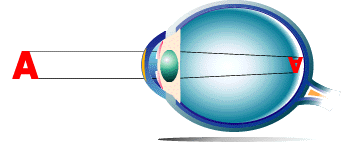
Oeil Myope
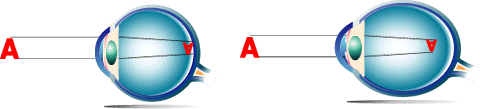
Un œil myope est un œil trop long, ceci se caractérise par une formation de l’image en avant de la rétine. Le nerf optique transmet donc une image floue au cerveau.
Plus la source du regard est éloignée et plus l’image sera floue. En revanche, un œil myope sera capable de voir de près, plus la myopie sera forte et plus la distance de vision nette sera courte.
La myopie peut être classifiée selon trois catégories en fonction du degré de correction nécessaire:
- une myopie est dite faible lorsqu’elle est inférieure à 3 Dioptries.
- une myopie moyenne se situe entre 3 et 6 Dioptries.
- une myopie forte est supérieure à 6 Dioptries.
Les signes de la myopie
L’enfant ne manifeste pas toujours sa gène visuelle, d’où la nécessité de faire régulièrement des visites de contrôle chez un ophtalmologiste.
Observations de tous les jours :
- Votre enfant plisse les yeux pour regarder au loin, ou alors il a tendance à se rapprocher excessivement de ses cahiers, livres ou des écrans ?
- Vous arrive t-il de plisser les yeux pour regarder un panneau de signalisation ? Ou de ne pouvoir reconnaître à distance les visages des personnes que vous connaissez ?
Vision normale
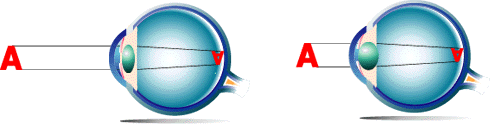
Pour un œil « normal », c’est à dire qui ne présente pas de défaut de vision, l’image d’un objet observé se focalise sur la rétine quelle que soit la distance de l’objet. Ceci grâce à l’accommodation du cristallin, très souple, qui se déforme.
Méthodes de correction de la myopie
Correction par lunettes
Pour la correction de la myopie, les verres correcteurs sont concaves, cela signifie qu’ils sont plus épais sur les bords qu’au centre. Ils sont donc inesthétiques et lourds, c’est pourquoi les myopies fortes étaient contraintes aux traditionnels « culs de bouteilles »: lunettes comportant des verres correcteurs particulièrement épais.
De nos jours, l’apparition de nouvelles matières pour les verres tend à diminuer cette tendance. La myopie se déclare tôt chez l’enfant (après 8 ans), en s’accentuant jusqu’à la stabilisation aux environs de 25 ans maximum ( la moyenne étant de 20 ans).
Verres minéraux:
Les plus anciens, ils ont la faculté de résister aux rayures et ont la capacité de foncer en fonction de la luminosité. En revanche, ils sont cassables et sont relativement lourds.
Les verres organiques:
Les verres en « plastique » sont très largement prescrits car leur particularité est leur légèreté et leur résistance aux chocs. Par contre, ils sont sujets aux rayures.
Les verres composites:
La dernière génération de verres est un alliage de matière composite et de verre minéral. Ils associent les particularités du verre minéral à la légèreté et à la rigidité du verre composite. Pour le moment, leur champ d’application se restreint aux faibles défauts visuels.
Correction par lentilles
Tellement discrètes qu’on a tendance à les oublier, les lentilles de contact sont utilisées majoritairement par les myopes (80% des lentilles de contact) mais aussi par les astigmates, les hypermétropes et les presbytes.
L’argument fort est l’esthétique car les lentilles de contact libèrent les myopes des verres épais inhérents à une forte myopie. Cependant, le port de lentilles de contact permet aux myopes non seulement d’avoir une meilleur correction avec de fortes myopies, mais aussi de disposer d’un champ visuel supérieur à celui des lunettes, celui-ci étant limité par les bords des montures.
L’utilisation des lentilles prend toute son importance pour les activités sportives ou professionnelles en supprimant en partie les inconvenants du port de dispositif de correction visuelle. Toutefois, le contact d’une lentille sur la cornée* n’est pas dénué de risques et l’application parfois sujette aux réactions allergiques de l’œil.
Pour de plus amples informations, n’hésitez pas à consulter votre ophtalmologiste traitant.
Entretien des lentilles
Des règles d’hygiène strictes sont à respecter avec ce type de correction en raison bien sûr du contact avec la cornée et le risque d’infection de cette dernière. Ne pas utiliser un produit d’entretien prévu pour un type de lentilles sur d’autres.
Exemple: solution pour lentilles rigides sur des souples.
*Cornée
Disque transparent enchâssé dans la sclérotique, qui forme la partie antérieure de la face externe du globe oculaire. Elle est composée de cinq couches: la couche épithéliale, la membrane élastique antérieure (membrane de Bowman ou de Reichert), la couche de substance propre, la couche basale postérieure (membrane de Descemet ou de Demours) et la couche endothéliale.
Correction au laser excimer
Le laser excimer (excited : excité, Dimer: molécule) est utilisé depuis longtemps dans l’industrie (1975) mais n’est que depuis peu employé dans la chirurgie réfractive. Après des expériences sur la fiabilité et sur les effets du laser sur la cornée des animaux, son application pour la correction de la myopie vit le jour. La première utilisation à proprement dit fut bien différente de celle actuelle car son rôle se limitait à remplacer le bistouri pour la kératotomie radiaire afin de diminuer les traumatismes post-opératoires. L’utilisation ophtalmologique fut véritablement réalisée en 1986 et le premier oeil fut traité en 1987.
Le laser excimer utilise un mélange de fluor et d’un gaz rare, l’argon. Son utilisation permet de ne pas avoir de contact entre l’instrument et la cornée, avantage certain contre une infection. L’émission d’un rayon dans le spectre de l’ultraviolet a pour conséquence de séparer les molécules d’où une vaporisation d’une pellicule de cornée à chaque impact (environ 0,25 µm). La finesse des pellicules de cornée vaporisées est la raison de la précision de correction du laser excimer.